As we discussed in a previous article, color dyed microspheres are increasingly replacing colloidal gold as markers for COVID-19 antigen tests due to their higher sensitivity, capacity and rich colors.
However, the system replacement from colloidal gold to colored microspheres is never easy, and there are many considerations in technology and operating procedures. As the expert of microspheres development and innovation, VDO Biotech has summarized the tips and guidelines in microspheres-based immunochromatography assay (ICA). In this article, we’ll discuss the techniques for coupling antibodies to color dyed microspheres.
There are 7 steps in immune-coupling process: washing, activating, washing, coupling, blocking, washing, melting and stock. Among them, the activating, coupling, and blocking are the critical steps. We’ll introduce tips and guidelines for these three key steps separately.

1. Activating
EDC and NHS are the commonly used activators of microsphere-based immuno-coupling. EDC is a highly soluble carbodiimide, which is used as an activation reagent of carboxyl groups in amide synthesis. The PH range is generally between 4.0 and 6.0, and in conjunction with NHS to improve coupling efficiency of antibodies. In the activation of carboxyl groups on microspheres, the mass ratio of microspheres to the activator and the mass ratio of EDC to NHS are appropriate.
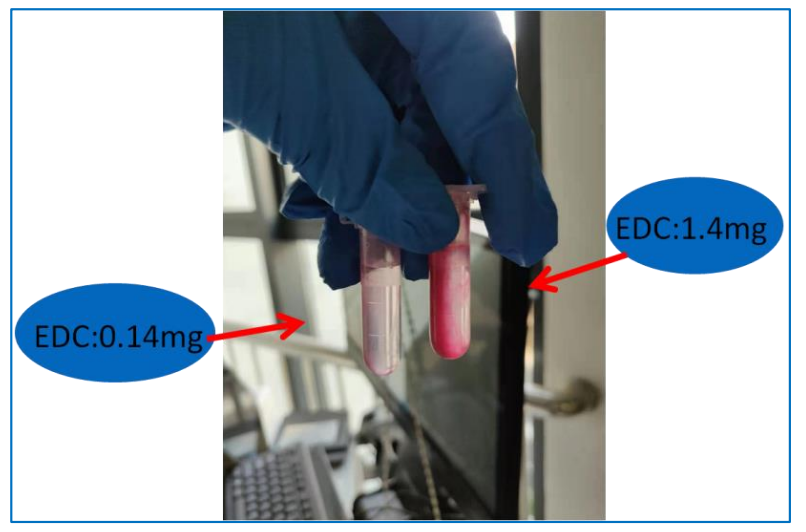
If the activator dose is too low, it will result in inadequate activation and reduce the coupling efficiency and ultimately result in reduced sensitivity of immunochemical reactions. If the activator dose is too high, the microspheres are gathered, and the morphology changed and ultimately resulting in the coupling efficiency of antibodies. For example, as shown in the figure below, when the EDC reached 1.4 mg, which is an over-dose amount, the microspheres are gathered after centrifugation and seriously affect the antibody coupling.
2. Coupling
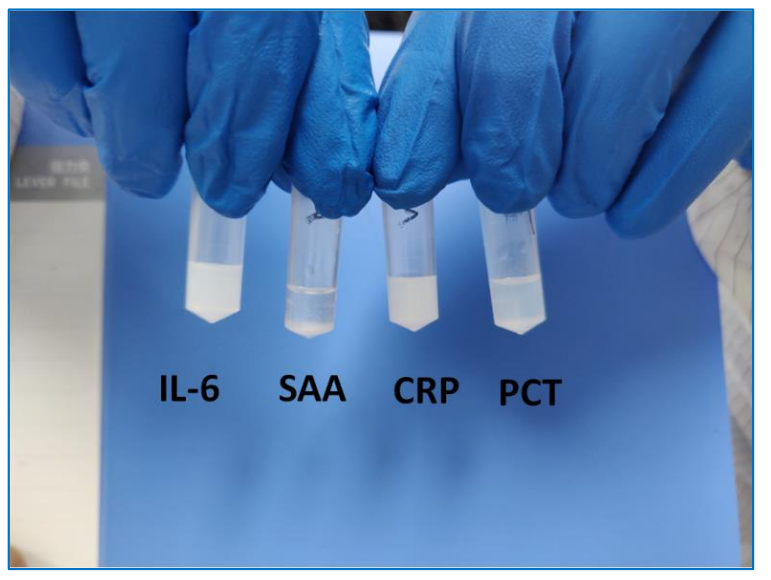
When different antibodies are coupled with microspheres under the same reaction system, coagulation might happen to some antibodies. It is mainly caused by the difference in isoelectric points of different antibodies. When the PH value of the system is not appropriate for the antibody, that will cause uneven charge distribution over the surface of a microsphere, and lead to coagulation, as shown in the figure below. Therefore, adjusting the PH value of the system can avoid the deposition of antibodies when coupling with the activated microspheres.
3. Blocking
The microspheres and the antibody are covalently bonded. However, the unbound surface of the microspheres still can adsorb other proteins, which will interfere with subsequent specific reactions. Bovine serum albumin (BSA) is generally regarded as an ideal blocking reagent, and can also be used as an alternative to skimmed milk powder and gelatin.
VDO Biotech SARS-CoV-2 Antigen Test Overall Solution
VDO Biotech has rich experience in nano-microsphere manufacturing and technological innovation capabilities. To better support customers' needs for COVID-19 detection raw materials, we have launched three core solutions: dyed latex microspheres, technical services for antigen chromatography detection system, and bulk package of complete set of antigen test materials.
l Team:Experienced professionals fully support from R&D to industrialization
l System:Nano-microspheres combined with customized auxiliary materials, one-stop solution for lateral flow system
l Technology:Relying on nano-microsphere design technology and large-scale production process, successfully achieve the upgrading based on existing products
VDO Biotech SARS-CoV-2 Antigen Test Product Overall Solution
l Supporting Raw Materials
l Supporting Materials(Microspheres Release Pad)
Related Article: Why are colored microspheres selected as markers for more and more COVID-19 antigen tests?
Download the Technical Note: Microspheres-based Immunochromatography Assay Technology
 Search
 Feedback
 Top
Top